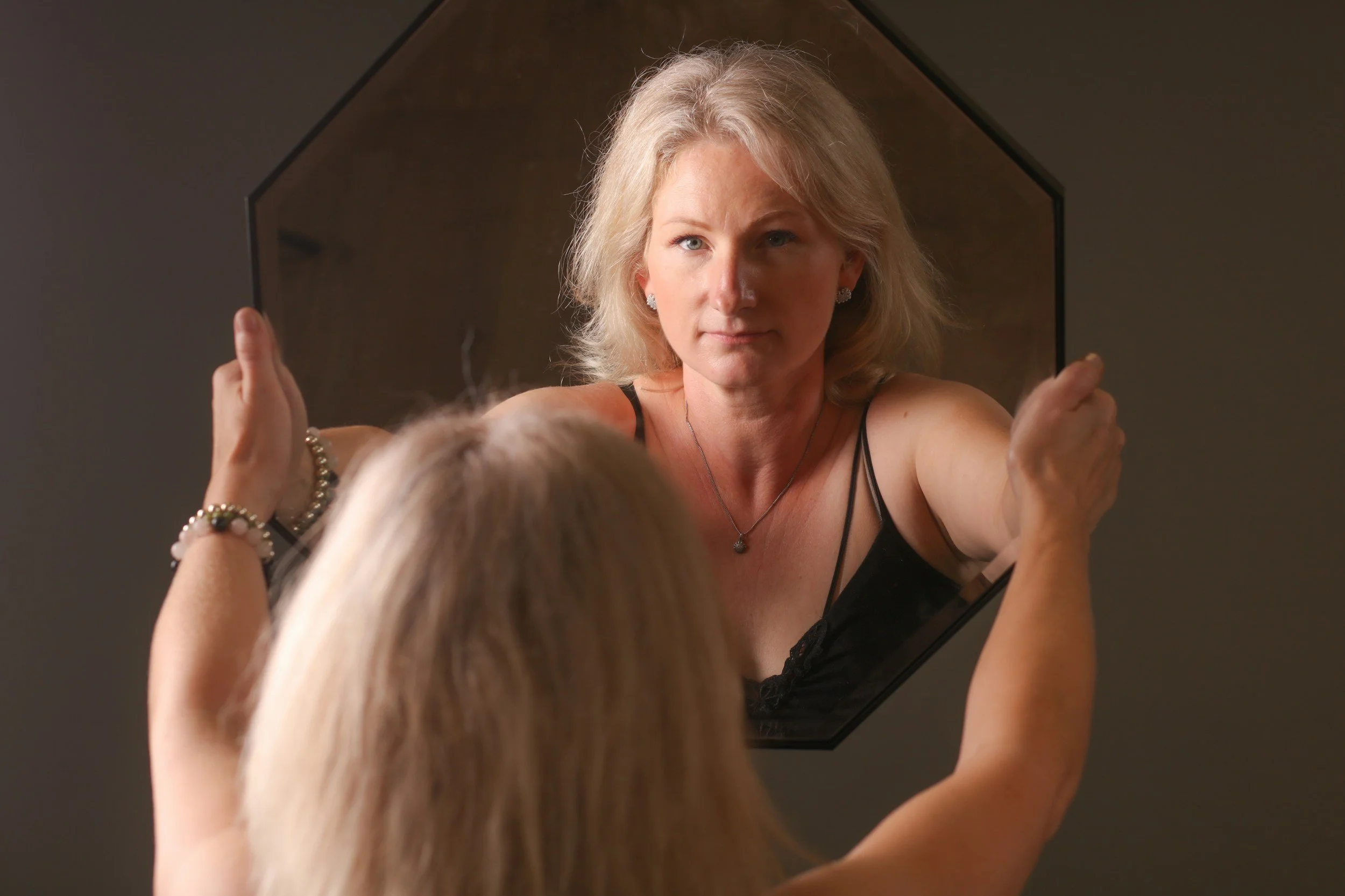
woman reaching toward her reflection in the mirror
There's a question that tends to arrive quietly….usually after the fanfare of "you did it" has faded. You're standing in front of the mirror, or scrolling through old photos, or catching your reflection in a store window, and you think: who is this person, exactly?
Not in a dramatic way. Just an honest, disorienting one. Your body looks different. Maybe your energy is different. The things that used to feel like "you" — your career pace, your role in your family, the way you moved through the world — might feel like they belong to someone else now. And underneath all of it sits a question nobody quite prepared you for: if I'm not who I was before, who am I now?
If you've felt this, I want you to know something clearly: this isn't a sign that something is wrong with you. It's one of the most common, most under-discussed parts of survivorship, and it has real research behind it. So today, let's talk about why this happens, what it actually looks like, and what tends to help.
Why Breast Cancer Shakes Your Sense of Self
It's tempting to think identity struggles after cancer are really just about vanity, or about missing an old body. The research paints something deeper. Breast cancer disrupts identity because breasts themselves carry enormous symbolic weight in how many women have been taught to understand womanhood, motherhood, and sexuality — which means changes to the body aren't just physical, they can feel like changes to the self. One review of the research put it plainly: many women come to believe that losing a breast means losing a fundamental part of their identity as a woman.
This isn't about anyone being shallow or overly focused on appearance. It's about the fact that so much of how we're taught to understand "who we are" gets tied to the body we've always lived in — and when that body changes suddenly and involuntarily, it makes sense that your sense of self would feel shaken too.
The numbers back this up. A recent survey found that 44% of women with breast cancer said the disease negatively affected their body image. That's nearly half. If you've felt this, you are solidly within the common experience, not the exception to it.

Take control. Live fully. Stay free.
The Body Becomes Unfamiliar — Even to Yourself
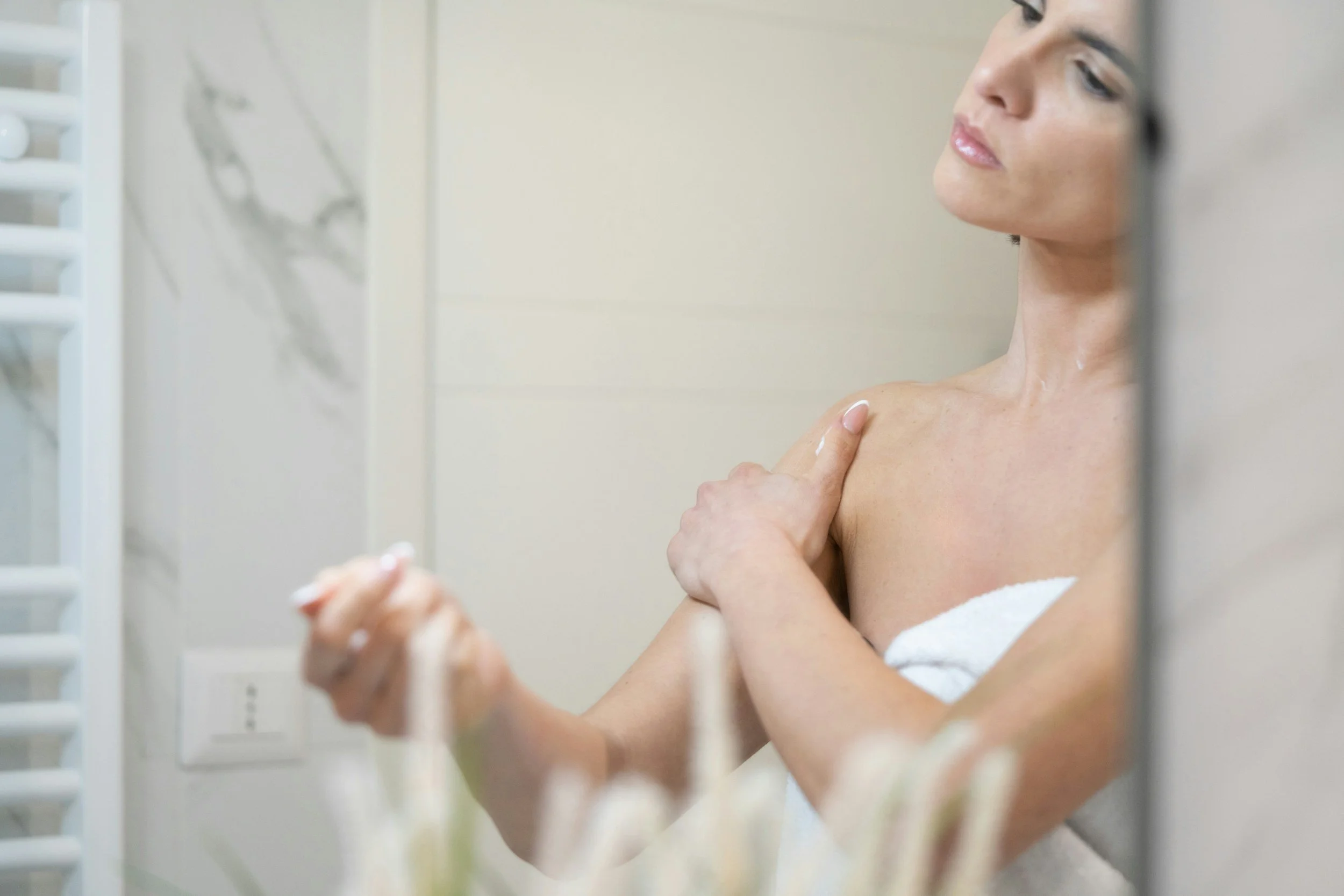
Here's something survivors rarely say out loud, but researchers have documented clearly: after treatment, many women describe their body as feeling less like home and more like a source of quiet threat. Every ache, every twinge, every unfamiliar sensation can trigger a kind of internal alarm — is this something? Researchers even have a name for the habit this creates: "checking behaviors," where survivors find themselves repeatedly touching or scanning areas of their body for anything that feels off, sometimes without fully realizing they're doing it.
If you've caught yourself doing this — quietly checking, monitoring, scanning — please hear this: it's not paranoia, and it's not "in your head." It's a well-documented response to having lived through something that taught your body it could betray you. Naming it as a known pattern, rather than a personal failing, is often the first step toward it loosening its grip.
woman in a relationship
It's Not Just Body Image — It's Role, Relationships, and Purpose
Identity disruption after cancer goes beyond the physical. Research on survivorship describes it as a tension between your old sense of "who I was" and the reality of who you are now — your role at work, in your family, in your friendships, even your sense of purpose can all feel like they need renegotiating. One review described this as an ongoing internal experience of uncertainty and altered social identity, separate from just body image, that can persist well past the point of being medically "done" with treatment.
This is part of why survivorship can feel so isolating even when everyone around you is celebrating your recovery. You may be trying to figure out who you are in your marriage, your job, your friendships — all while the outside world has already moved on to "you beat it, now go live your life." That gap between the internal work and the external expectation is real, and it deserves patience rather than pressure to snap back to "normal."
What Actually Helps, According to Research
This is the part I want you to hold onto. Identity rebuilding after cancer isn't about willing yourself back to who you were before — the research suggests it's closer to integration than restoration.
Body compassion, not body correction.
Recent research on breast cancer survivors found that how you relate to your changed body — with compassion or with harsh self-judgment — significantly shapes body image outcomes over time. Treating your body kindly (rather than as a project to fix or a betrayal to punish) is directly tied to feeling more at peace with it.
Reevaluating your own standards, not chasing your old ones.
Research describes survivors integrating a new body image successfully when they reevaluate what their body means to them, rather than measuring themselves against who they were before diagnosis. This isn't about giving up on feeling good in your body — it's about defining "good" on new terms that fit who you are now, rather than forcing yourself back into an old definition that may no longer apply
Small, tangible acts of reclaiming.
Interestingly, the same survey that found 44% experienced negative body image also found real paths back: physical activity helped nearly a third of women feel more confident, and simple things like clothing choices and getting back into a beauty routine helped many women feel like themselves again. These aren't superficial fixes — they're small, repeated acts of choosing your own identity rather than waiting to "feel like yourself" before acting like it.
There's often unexpected appreciation, too.
It's not all difficulty — the same research found 59% of women reported feeling more appreciative of their bodies and everything they'd been through since diagnosis. Struggle and gratitude aren't mutually exclusive; many survivors hold both at once.
A Gentle Reframe: You're Not Going Backward, You're Integrating Forward
If there's one thing I want you to take from all of this research, it's this: rebuilding identity after breast cancer was never about returning to who you were before diagnosis. That version of you didn't know what you know now, hadn't survived what you've survived, and hadn't discovered whatever strength got you through it.
You're not trying to go back. You're integrating everything — the fear, the changes, the unexpected gratitude, the new limits, the new clarity — into a fuller version of yourself that includes all of it. That's not a lesser version of who you were. It's simply a more complete one.

woman accepting her body
Hair, Scars, and the Physical Reminders of "Before and After”
For many survivors, certain physical changes become the most visible, daily reminder of everything that's happened — hair that grew back different, scars from surgery, a body shape that's shifted. These aren't just cosmetic details. Research consistently shows that visible physical changes act as a kind of ongoing marker that separates "before" from "after," making it hard to simply move on when the reminder is present every time you look in the mirror.
This is worth naming plainly: there is nothing wrong with grieving these changes, even while also being grateful to be alive. Both things can be true. A scar can be evidence of survival and something you wish you didn't have to look at, in the same breath. Giving yourself permission to hold both feelings — rather than forcing yourself to only feel grateful — tends to be part of what actually allows integration to happen over time.
Talking to the People Who Love You About This
One of the harder parts of this particular struggle is that it's largely invisible to the people around you. Your friends and family can see that your hair grew back, that your scars have healed, that your scans are clear — and quite reasonably, they may assume that means you feel like yourself again. When you don't, it can feel awkward or even embarrassing to say so.

women who are in conversation
A few honest ways to open that conversation, if it would help:
- "I know I look like myself again, but I'm still figuring out who that even is right now."
- "Can I talk to you about something that's been on my mind, even though everything looks 'fine' on the outside?"
- "I'm not looking for advice right now, I just need you to know this is still something I'm working through."
You don't owe anyone a tidy explanation. Simply naming that the internal experience doesn't match the external picture is often enough to invite the people who love you into understanding, rather than assuming.
Frequently Asked Questions
Is it normal to feel like a different person after breast cancer treatment?
Yes. Research on survivorship identity describes this as a common, well-documented experience — an ongoing negotiation between who you were before diagnosis and who you are now, separate from and often deeper than body image alone.
Why do I still feel disconnected from my body even though my scans are clear?
Clear scans address the medical reality, but the emotional and psychological relationship with your body often takes longer to rebuild. Checking behaviors, hypervigilance, and a sense of your body as unpredictable are well-documented responses, not signs that something is wrong with your recovery.
Will I ever feel like "myself" again?
Many survivors describe reaching a place of integration rather than a full return to their old sense of self — meaning you come to feel like a complete version of yourself that includes what you've been through, rather than reverting to exactly who you were before diagnosis. Both grief for the old version and appreciation for who you're becoming can coexist.How do I stop constantly checking my body for signs something is wrong?
This is an extremely common pattern, sometimes called "checking behavior," documented in survivorship research. Working with body compassion rather than body vigilance, and speaking with a therapist familiar with cancer survivorship if the checking feels compulsive or distressing, can both help loosen its hold over time.
Where This Leaves You
You don't need to have this figured out today. If the question "who am I now?" has been sitting quietly in the back of your mind, that's not confusion to fix — it's a completely normal part of integrating everything you've been through.
Start small. Maybe it's one act of body compassion instead of criticism today. Maybe it's wearing something that makes you feel like you, just for yourself. Maybe it's simply naming the question out loud to someone who won't rush you toward an answer.

catherine haffey
And if you're finding that this question feels bigger than you want to sit with alone — that's exactly the space I hold in my free workshop. We walk through rebuilding both strength and identity together, with other women asking the exact same question. I'd love for you to join us.

---Sources
- Breast Cancer Now, "44% of Women With Breast Cancer Say Breast Cancer Negatively Impacted Their Body Image"
- Body Image Alteration in Women with Breast Cancer: A Concept Analysis, National Library of Medicine
- Relating to a New Body: Understanding the Influence of Body Compassion and Metacognition on Body Image in Breast Cancer Survivors, Cogent Psychology
- Psychosocial Health and Survivor Identity of Breast Cancer Survivors, systematic scoping review
